Best Practices & Discovery
An overview of market trends and best practices, so you know what other organizations are already doing.


We help you decide which workplace tools need to be under your control, which can stay as they are, and how to get there without disruption.
Mail, chat, and file sharing now sit at the center of risk management, business continuity, and strategic control. Yet many organizations have never mapped where these services run, who controls them, and which dependencies they create.
It’s a topic for CIOs, CISOs, and heads of IT. More and more, it’s one for management too.
For Most Organizations, the Answer Is Hybrid
Some components stay where they are. Others move to where you have more control. In this short video, Gil Oliveira and Manuel Voigt explain how we help you figure out which is which.
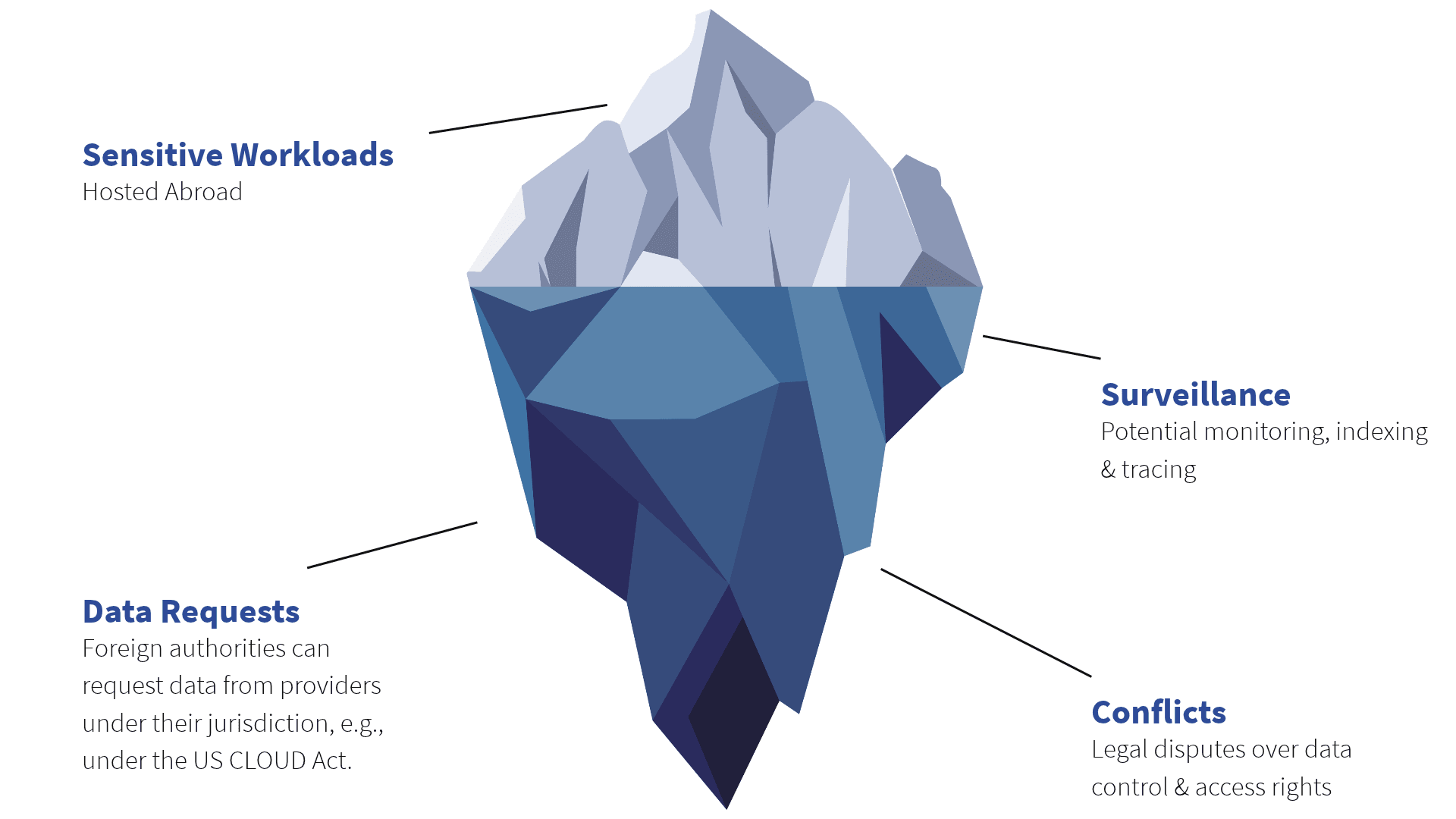
Above the waterline are the tools your teams open every morning. Below it are the questions that decide how much control you actually have over them.
The first is jurisdiction. The US CLOUD Act obliges US-based providers to hand over data in response to valid US legal requests, wherever the servers are located. Courts have already struck down two earlier EU–US data transfer frameworks, and the current one still faces legal challenges. At the same time, GDPR, NIS2, DORA, and the Swiss DSG expect you to know where your data is, who can reach it, and how you would exit a critical provider. Then there are the questions that rarely make it into a project plan:
You're not alone in asking. Around 80% of European business spending on cloud software and services – about €265 billion a year – goes to US companies (Asterès for Cigref, 2025). 74% of publicly listed European companies use US-based email services (Proton, 2025). And 61% of Western European CIOs and IT leaders say geopolitics will increase their reliance on local or regional cloud providers (Gartner, 2025).
We map every workplace service – identity, mail, files, chat, video, office, AI, and clients – and check each one against the same six questions.

Are the provider and the data subject to Swiss or EU jurisdiction?

Are there realistic alternatives with reasonable effort?

Can all data be exported in open formats?
Are open standards and documented interfaces used?

Can the service run independently of the vendor?
Can you shape further development, up to taking it over yourself?
Connect with our open source experts to assess your current workplace environment, identify potential risks, and explore practical steps toward greater digital sovereignty.
Nobody walks straight to the summit. You start at base camp with a decision base everyone can stand behind, then climb in stages you can test along the way.
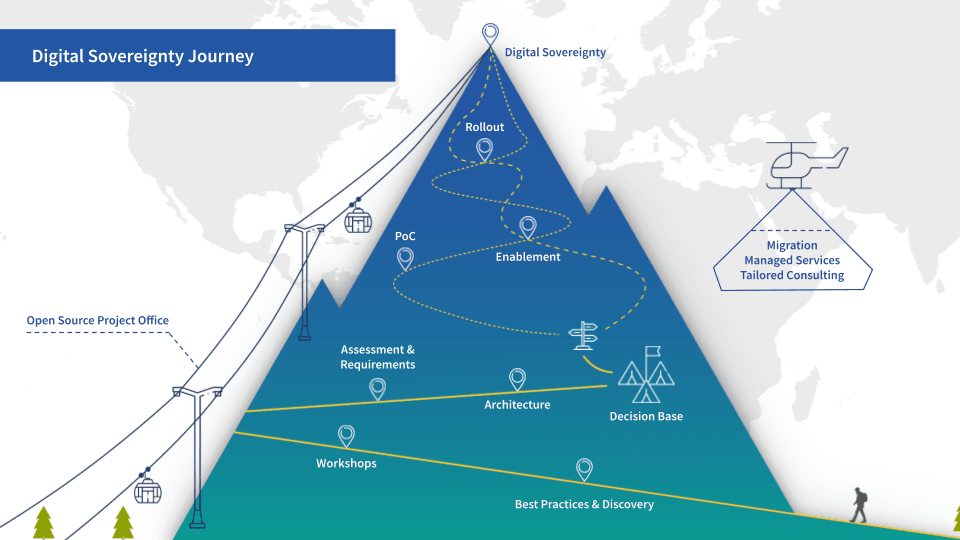
What each step involves, from the first overview to the rollout.
An overview of market trends and best practices, so you know what other organizations are already doing.
Kickoff workshops to understand the status quo of your workplace and define the use cases.
We analyze the in-scope IT ecosystem against the six questions and document your requirements.
A target blueprint, technical design, and security concept based on your requirements.
Architecture direction, governance, and a prioritized action plan. This is your base camp.
Training and user acceptance, so people actually adopt the new tools.
Test functionality and integrations with your own users before you commit.
Technical implementation and user adoption with continuous support and improvement.
Talk to our open source consultants to analyze your current setup, evaluate risks, and identify practical next steps.
We're vendor-independent: no predefined stack and no product agenda. Besides consulting and strategy, we design, migrate, build software, and run your workplace services around the clock. Adfinis is ISO 27001- and ISO 9001-certified.


Trusted by Public Sector & Regulated Enterprise
To guarantee complete control over sensitive judicial records, the Swiss Federal Supreme Court chose to build an independent, self-hosted office setup. Adfinis deployed Collabora Online and LibreOffice using automated Ansible Playbooks, giving their teams full operational freedom without third-party data risks.

Operating across heavily regulated European markets means compliance and high availability are essential for Helvetia Insurance. Adfinis delivers enterprise-grade Linux engineering and ongoing operational support, helping them streamline core IT processes while maintaining strict regulatory oversight.
DIG-IT needed a reliable, sovereign digital workplace to enhance cross-departmental collaboration without locking themselves into proprietary ecosystems. By implementing customized open source infrastructure and automated workflows, Adfinis gave them total control over their data and long-term tech roadmap.
Get in Touch!